Preliminary Aerodynamic Design and Wing Optimisation for a Hypothetical Electric General Aviation Aircraft
Preliminary design of a wing and emergency parachute for a hypothetical four-seat electric aircraft. I treated airfoil selection as an optimisation problem, then sized the wing, flaps and parachute, and checked where the wing stops working as speed rises.
- Context
- University of Limerick coursework, ME4424 Aerodynamics 1
- When
- Nov–Dec 2025
- Tools
- Python, XFOIL, XFLR5
- Report
- Full report (PDF)
Problem
Batteries store little energy for their mass, so for an electric aircraft the lift-to-drag ratio of the wing largely sets the range. The brief was a 2,000 kg four-seat aircraft cruising at 300 km/h at 3,000 m with a 400 kg battery. The wing had to maximise cruise L/D and still make enough lift for take-off and landing, and the aircraft needed an emergency parachute.
- Take-off: CL of at least 0.818 at 46.67 m/s, a 1.2 times stall margin.
- Landing: CL of at least 1.097 at 40.28 m/s, a 1.3 times stall margin.
- Parachute: no more than 1 g during deceleration, then a 28 km/h descent.
My role
Individual coursework report. I designed the analysis workflow, wrote the Python scripts that drove XFOIL and scored the airfoil and flap options, ran the XFLR5 studies, and did the parachute and critical Mach number calculations.
Method
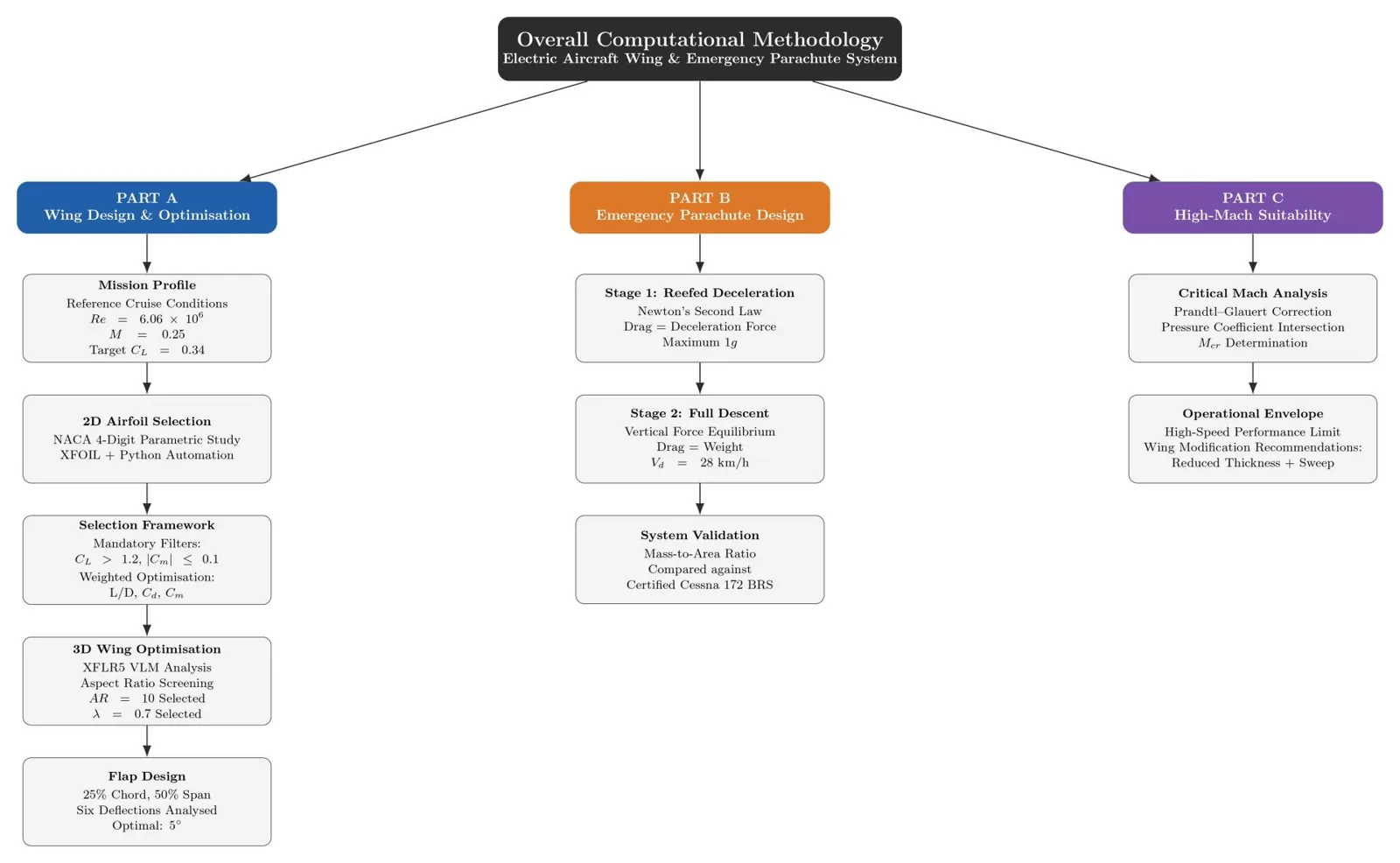
- Flight conditions. Air density of 0.91 kg/m³ at 3,000 m from ISA tables, a mean aerodynamic chord of 1.49 m taken from a Cessna 172, and a cruise CL of 0.34 at Mach 0.25.
- Airfoil sweep. 171 NACA 4-digit airfoils (camber 2–6%, camber position 20–60%, thickness 12–18%, angle of attack −4° to 18°) run through XFOIL by a Python script built on my earlier airfoil study.
- Two-stage selection. First a filter: pitching moment no worse than 0.1 and clean-airfoil Cl above 1.2 between 0° and 8°. Then a weighted score: L/D 40%, minimum drag 20%, pitching moment 20%, maximum lift 10%, stall character 10%.
- 3D wing. XFLR5 vortex lattice runs: aspect ratio 7 to 10 at a taper ratio of 0.75, then taper ratio 0.65 to 0.80 at aspect ratio 10.
- Flaps. A plain flap on 25% of the chord and 50% of the span at 0° to 30° in 5° steps. A Python script scored over 450 operating points on lift achieved (35%), efficiency (25%), operating angle (20%), stall margin (15%) and mechanical simplicity (5%).
- Range, parachute, high Mach. Range from the Breguet equation for electric aircraft, the parachute from Newton's second law in two stages, and the critical Mach number from the Prandtl–Glauert corrected pressure coefficient against the sonic threshold.
Assumptions
- XFOIL is a 2D viscous panel method. It is good for comparing airfoils at cruise but less reliable near stall.
- The scoring weights are my design judgement. A different weighting would pick a different airfoil.
- Range neglects fuselage drag. It uses 600,000 J/kg battery specific energy, 0.80 powertrain efficiency and a 400 kg battery.
- The parachute drag coefficient is 1.42 (a hemispherical canopy). Airframe drag is treated as negligible next to the parachute (under 2% of the target force).
- The wing is designed for incompressible flow at Mach 0.25.
- The airfoil sweep ran at the cruise Reynolds number of 6,064,796 with Ncrit 9.
Result
- Cruise L/D
- 31.46
- Range
- 308 km
- Critical Mach number
- 0.64
- Grade
- 96%
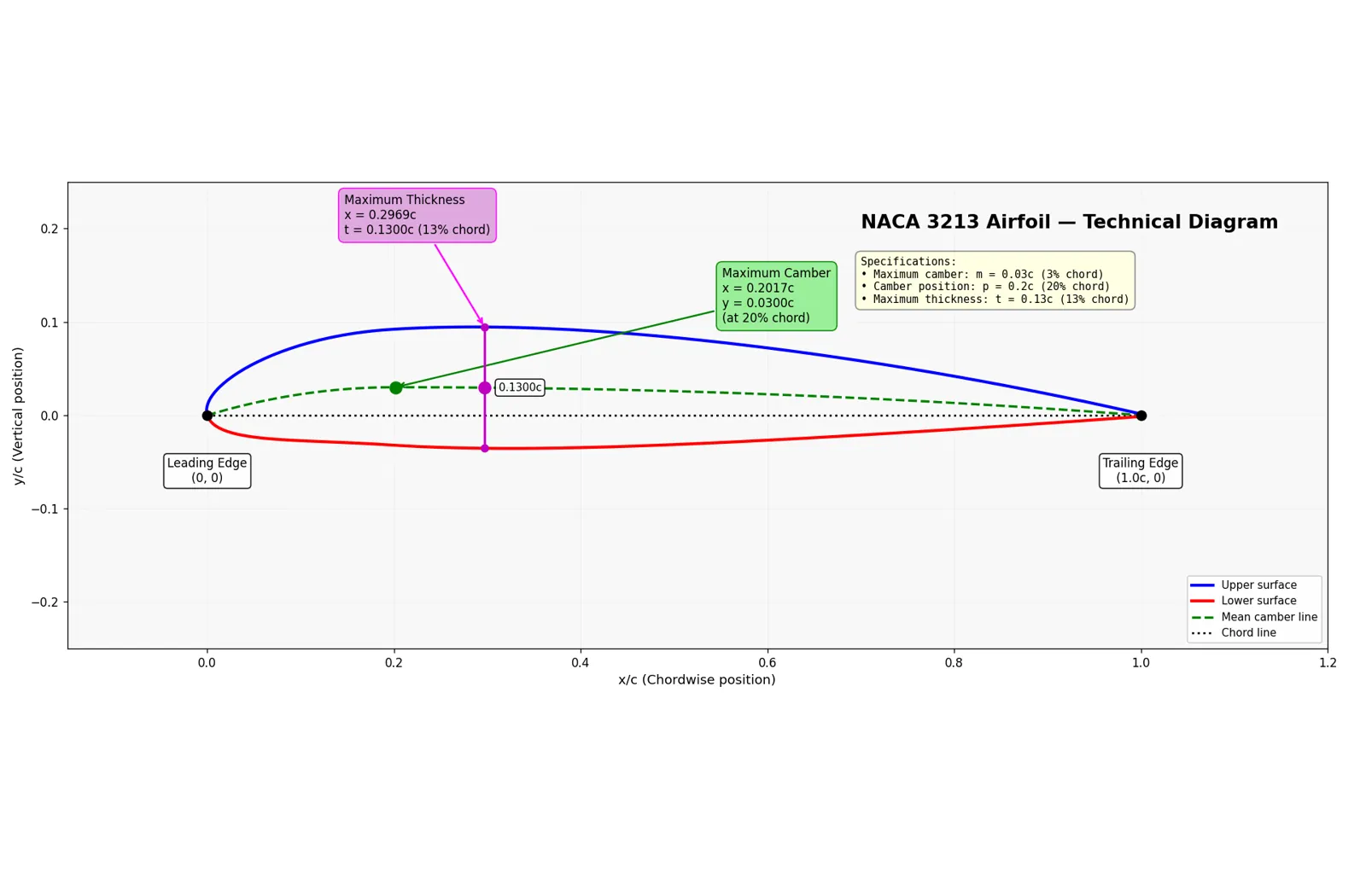
- Airfoil: NACA 3213. Of 171 airfoils, 75 failed on pitching moment and 32 on lift, leaving 64. The NACA 3213 had a maximum L/D of 172.3 and a pitching moment of 0.051. The NACA 6612 scored higher on L/D (210.6) but its pitching moment of 0.199 would need a bigger tail. The NACA 2212 was stable but did not meet the lift requirement.
- Wing: aspect ratio 10, taper ratio 0.7. Going from aspect ratio 7 to 10 raised cruise L/D by 12%. Taper ratio changed cruise L/D by less than 0.5%, but 0.7 had the best Oswald efficiency (0.929) and the most progressive stall.
- Flaps: 5° for both take-off and landing. Take-off reached CL 0.853 (4.3% margin) at L/D 27.8. Landing reached 1.131 (3.1% margin) at L/D 22.9. Larger deflections gave more lift but cut L/D by about 30% by 30°.
- Parachute: 4.4 m² reefed, then 373 m² fully open. Opening the full canopy at cruise speed would exceed 9.5 g, which is why it needs two stages.
- High speed: local flow reaches sonic speed at Mach 0.641, so this wing is unsuitable for Mach 0.8 without a thinner section, 25–35° of sweep or a supercritical airfoil.
Verification
- The calculated parachute loading of 5.36 kg/m² is close to the 5.16 kg/m² of the certified BRS system for the Cessna 172.
- At Mach 0.5 the XFLR5 lift, drag and pressure coefficients rose by 15.4–15.7%, against 15.5% predicted by the Prandtl–Glauert correction.
- The filters removed the NACA 6612 and 2212, which would otherwise have ranked at the top, for stated reasons, so the choice is not just the top of a ranking.
The L/D of 31.46 is a vortex lattice estimate with no fuselage drag.
What I’d change
The report's own next steps are to add fuselage drag and a structural analysis, so the range figure covers the whole aircraft, and to repeat the design with sweep or a supercritical section for high-subsonic flight.